
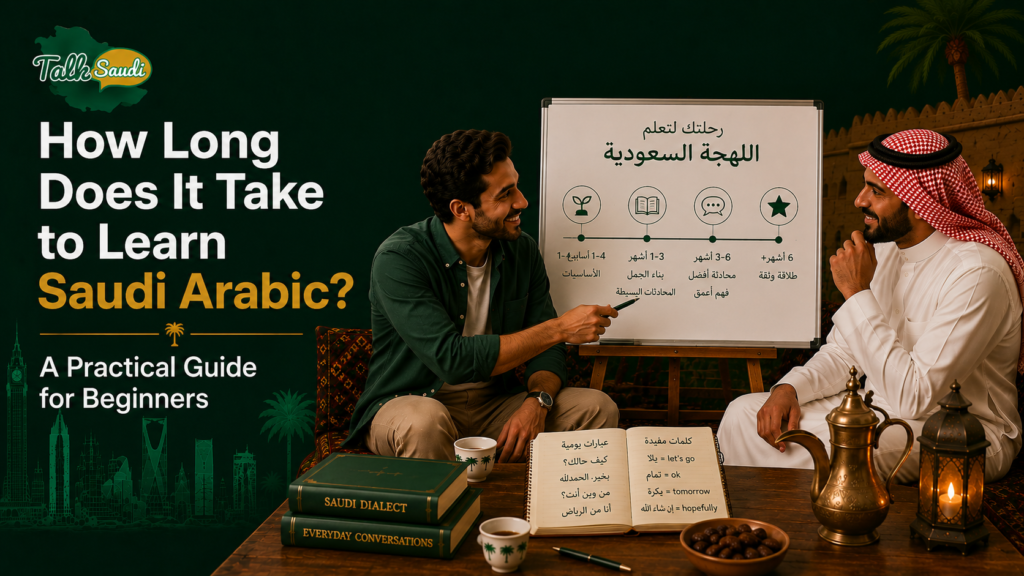
Picture this: you’ve just accepted a job offer in Riyadh, or maybe you’ve fallen for someone from Jeddah, and now you’re staring at your calendar trying to figure out how long to learn Saudi Arabic before you actually need it. This question keeps countless learners up at night, because unlike learning to cook a new dish or pick up a new software tool, language progress feels invisible until suddenly it isn’t. The good news is that how long to learn Saudi Arabic has a far more concrete answer than most people assume, once you understand the variables that actually drive the timeline. This guide breaks down exactly what shapes your pace, what milestones to expect, and how to avoid the traps that stretch a six-month goal into a two-year struggle.
The Question Behind the Question: What Are You Actually Trying to Do?
Before any timeline means anything, it helps to define what “learning” actually looks like for you. Someone who wants to survive a two-week vacation has a wildly different target than someone relocating permanently for work. When people ask how long to learn Saudi Arabic, they’re often really asking one of three separate questions: how long until I stop feeling lost, how long until I sound natural, or how long until I forget I’m even translating in my head. Each of these has a different answer, and confusing them is one of the biggest reasons learners feel like they’re failing when they’re actually right on track.
Timeline by Learner Type: Three Real-World Paths
Rather than a single generic timeline, it’s more useful to look at how long to learn Saudi Arabic through the lens of who’s actually asking.
The Traveler (Goal: Survive and Enjoy a Trip)
Someone preparing for a two-to-four-week visit typically needs only a few weeks of focused preparation. This includes greetings, transportation phrases, food-related vocabulary, and polite expressions. A traveler with even three to four weeks of daily fifteen-minute practice can walk into markets, taxis, and restaurants with reasonable confidence.
The Relocator (Goal: Build a Life There)
Someone moving to Saudi Arabia for work or family reasons is playing a longer game. This learner typically needs four to six months before daily errands feel effortless, and closer to a year before workplace banter, humor, and fast-paced group conversations feel natural. The stakes here are higher, so the investment of time is proportionally larger.
The Connector (Goal: Deepen a Relationship or Friendship)
Someone learning because of a partner, in-laws, or close friends often progresses faster than either of the above, simply because the emotional motivation drives more consistent practice. This learner may reach warm, natural conversation within four to five months, since real relationships provide constant, low-pressure practice opportunities that structured study alone can’t replicate.
The Five Variables That Actually Control Your Speed
Forget generic averages for a moment. These are the real levers that determine how long to learn Saudi Arabic for you specifically.
1. Starting Point
Someone who already reads Arabic script or has studied another dialect starts with a running head start. Someone starting completely fresh, unfamiliar sounds, script, and grammar all at once, needs more runway before things click.
2. Weekly Exposure, Not Total Hours
Twenty minutes a day for six months beats four hours crammed into a single Saturday every single time. Language retention depends on spaced repetition, and daily micro-sessions train your brain far more effectively than occasional marathon sessions.
3. Feedback Loop Speed
Learners who get corrected within seconds of making a mistake, ideally in live conversation, fix errors permanently much faster than those who repeat the same mistake for weeks in solo study before anyone points it out.
4. Emotional Stakes
Somewhat counterintuitively, learners with a personal reason (a partner, a job, a move) consistently outpace learners studying out of general curiosity. Motivation isn’t just a nice-to-have, it directly predicts how often you’ll actually show up to practice.
5. Method Fit
Studying formal Arabic textbooks when your goal is casual conversation is like training for a marathon by practicing sprints. The mismatch between method and goal silently adds months to almost everyone’s timeline.
A Practical Milestone Checklist Instead of a Rigid Calendar
Instead of obsessing over exact months, track these real-world milestones. They tell you far more about your progress than a date on a calendar ever could.
- I can greet someone and ask how they’re doing without hesitating
- I can order food or a drink without switching to English
- I can understand a slow, simple question and answer it appropriately
- I can hold a two-minute conversation about my day
- I can catch the general meaning of a fast conversation between two locals
- I can make a joke, or understand one, without it falling flat
- I can handle an unexpected question without freezing
Hitting these markers, in roughly this order, is a far more honest measure of how long to learn Saudi Arabic than any generic “three months” claim floating around online.
What Slows People Down (And How to Avoid It)
Studying the Wrong Version of Arabic
Countless learners spend months on formal, written Arabic assuming it will transfer directly to spoken conversation. It doesn’t, at least not smoothly, and this mismatch is one of the single biggest reasons people feel stuck despite putting in real effort.
Silent Studying Without Speaking
Reading and listening build recognition, but speaking builds retrieval, the actual skill of pulling words out of your brain in real time. Learners who avoid speaking until they “feel ready” often delay their own progress by months.
Inconsistent Practice Patterns
Two intense weeks followed by a month of silence resets far more progress than people expect. The brain needs regular, low-stakes repetition to move vocabulary from short-term recognition into long-term, automatic recall.
No External Accountability
Self-study without anyone checking in tends to fade quietly. A scheduled lesson, even once a week, creates a built-in reason to keep showing up, which compounds significantly over months.
Speeding Things Up: A Short, Honest Action Plan
- Pick your real goal first. Traveler, relocator, or connector, your target shapes everything else.
- Practice daily, briefly, rather than occasionally, intensely. Fifteen focused minutes beats an exhausting two-hour session once a week.
- Speak from day one, imperfectly. Waiting for confidence before speaking simply delays the moment you actually build it.
- Get corrected by a real person. A native speaker catching your mistakes in real time saves you from repeating them for weeks.
- Attach practice to something you care about. A relationship, a job, an upcoming trip, anything that makes the stakes personal will keep you consistent when motivation dips.
Frequently Asked Questions
- Realistically, how long to learn Saudi Arabic for basic travel conversations?
Around three to four weeks of focused daily practice is usually enough for greetings, ordering food, and handling simple transactions.
- How long to learn Saudi Arabic well enough for a full-time job?
Most learners need four to six months before daily work conversation feels comfortable, with a full year often needed for humor and fast group discussions.
- Is it faster to learn Saudi Arabic if I already speak another Arabic dialect?
Yes, shared grammar patterns and vocabulary roots typically shorten the timeline noticeably compared to starting from zero.
- Does living in Saudi Arabia automatically speed up the process?
It helps significantly, but only if paired with active speaking practice. Passive exposure alone, without conversation, progresses much more slowly.
- Can busy professionals still learn Saudi Arabic efficiently?
Yes, short, consistent daily sessions fit easily into busy schedules and often outperform occasional long study blocks.
- What’s a realistic weekly time commitment for steady progress? Four to six hours per week, split across several short sessions, tends to produce noticeable progress within a few months.
- Does skipping formal grammar study slow things down?
Not necessarily, since spoken fluency relies more on pattern recognition through conversation than on memorizing formal grammar rules.
- How do I know if I’m actually progressing versus just memorizing phrases?
If you can handle an unexpected question or comment without freezing, that’s a strong sign you’re building real conversational ability, not just scripted responses.
- Is six months enough to reach genuine conversational comfort?
For many learners with consistent practice, six months is enough for comfortable daily conversation, though deeper fluency often takes longer.
- What single change would shorten this timeline the most?
Adding regular live conversation practice with a native speaker tends to produce the fastest, most noticeable improvement for most learners.
Final Thoughts
There is no fixed timeline for learning Saudi Arabic—it depends on your goals, consistency, and learning approach. Regular practice with native speakers is the fastest way to make real progress.
With Talk Saudi, you can learn through structured live lessons with native instructors, tailored to your level and personal goals.