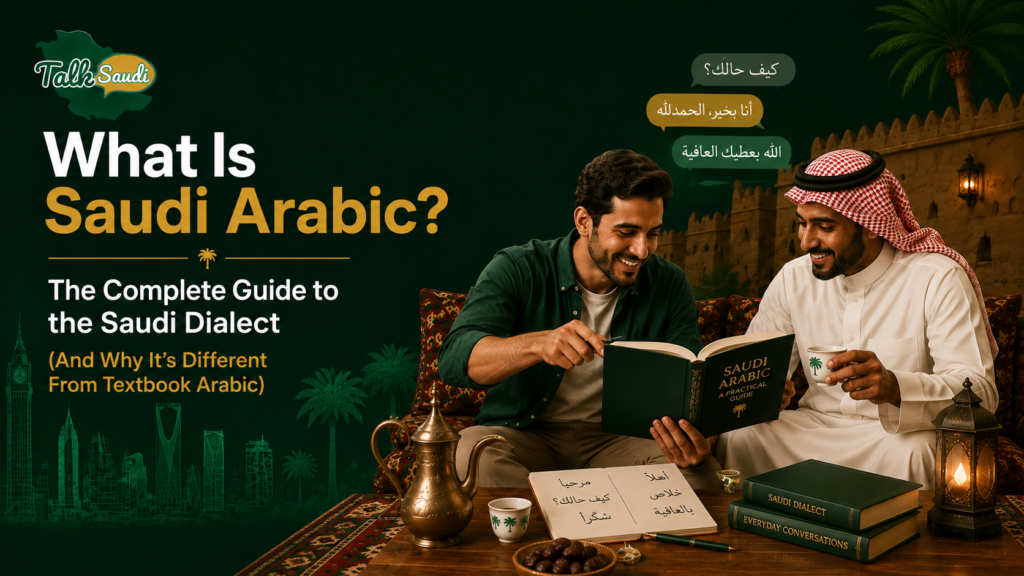
If you’ve ever tried to ask a native speaker “what is Saudi Arabic?“, you probably got more than one answer. Ask someone from Riyadh and they’ll describe something different from what someone in Jeddah, Dammam, or Abha would tell you. That’s because Saudi Arabic isn’t one fixed language you can learn from a single textbook — it’s a living identity, shaped by desert tribes, pilgrimage cities, coastal trade routes, and generations of families passing speech down like an heirloom.
This guide takes a different approach than most “learn Saudi Arabic” articles online. Instead of just throwing a list of phrases at you, it breaks down what actually makes the Saudi dialect unique, where it came from, how it differs from the Arabic taught in schools, and — most importantly — how to start speaking it for real, with structured help from platforms like Talksaudi.
What Is Saudi Arabic, Really? Defining an Identity, Not Just a Dialect
When people ask what is Saudi Arabic, they’re usually expecting a simple linguistic answer: grammar rules, a vocabulary list, maybe a pronunciation guide. But ask any Saudi and they’ll tell you it’s more than that — it’s a marker of identity.
The way someone speaks in Saudi Arabia can reveal:
- Which city or region they grew up in
- Which tribe or family lineage they come from
- Their generation — older and younger Saudis often speak differently
- Even their social circle, since slang shifts constantly among younger speakers
This is exactly what makes the Saudi dialect so fascinating to outsiders: it isn’t static. It shifts subtly from person to person, carrying personal and regional history in every sentence — which is also why “just learning some words” rarely gets learners very far.
A Country of Many Voices: Saudi Arabic Regional Dialects Explained
Saudi Arabia is vast — roughly the size of Western Europe — and its dialect map reflects that scale. Rather than one uniform way of speaking, the Kingdom is home to several distinct regional accents. This regional diversity is the biggest reason what is Saudi Arabic rarely has a one-line answer.
Najdi Arabic — The Central Heartland Voice
Spoken across Riyadh and the central Najd region, this is often considered the dialect closest to the “prestige” form of spoken Saudi Arabic, historically tied to Bedouin tribal speech. It tends to be sharper and more consonant-heavy than the coastal dialects, and it’s the accent most associated with national media and official life today.
Hijazi Arabic — The Western Coastal Voice
Spoken in Jeddah, Makkah, and Madinah, Hijazi Arabic carries centuries of influence from pilgrims and merchants who passed through the holy cities from across the Islamic world. The result is a softer, more melodic, and more “layered” dialect, with loanwords and rhythms borrowed from Turkish, Persian, Urdu, and other languages carried in by generations of visitors.
Eastern Arabic — The Gulf Trade Voice
Near the Gulf coast, in cities like Dammam and Al-Khobar, the local speech leans closer to the wider Gulf Arabic family shared with Bahrain, Qatar, and Kuwait — shaped by decades of maritime trade, pearl diving history, and cross-border movement.
Southern Arabic — The Highland Voice
Toward the mountainous south, in regions like Asir and Jazan near the Yemeni border, the dialect carries vocabulary, intonation, and expressions found nowhere else in the country — a reminder that “Saudi Arabic” is really an umbrella term for several distinct spoken traditions.
Saudi Arabic vs. Modern Standard Arabic: The Real Difference
Most people who study Arabic formally are taught Modern Standard Arabic (MSA) — the standardized version used in books, news broadcasts, and official documents. MSA is consistent across every Arab country, but it’s almost never how people actually talk at home. Understanding this contrast is the single biggest “aha moment” for new learners of Saudi Arabic.
Here’s how they compare in practice:
Where each is used: Modern Standard Arabic lives in writing, media, and official settings. Spoken Saudi Arabic lives in homes, streets, and everyday conversation.
Consistency: MSA is nearly identical across every Arab country. The Saudi dialect varies noticeably from one region to the next, as covered above.
Grammar: MSA follows highly structured classical grammar rules, including case endings that are rarely used in speech. Spoken Saudi Arabic simplifies much of this, favoring natural, efficient speech patterns.
How it’s learned: MSA is learned through formal schooling and textbooks. The Saudi dialect is learned by growing up hearing it — or, for foreigners, through focused immersion and dialect-specific coaching.
Emotional tone: MSA tends to sound neutral and formal, even distant. The Saudi dialect is warm, expressive, and deeply personal — full of blessings, endearments, and hospitality baked directly into everyday phrases.
This gap is exactly why so many learners feel lost when they land in the Kingdom after years of formal Arabic study — the language they hear on the street barely resembles what they memorized in class. If your goal is real conversation with real people, learning MSA alone simply won’t get you there.
The Historical Roots Behind the Saudi Dialect
To really understand what is Saudi Arabic today, it helps to look backward. Long before modern national borders existed, the Arabian Peninsula was home to tribes whose speech patterns evolved over centuries of migration, trade, and oral storytelling — poetry, in particular, played a huge role in preserving and spreading spoken Arabic long before it was widely written down.
Later, as Makkah and Madinah became yearly destinations for pilgrims from every corner of the Muslim world, new words and expressions blended into local Hijazi speech. Coastal trade routes along the Gulf and Red Sea added further linguistic layers, while the rise of modern Saudi cities in the twentieth century introduced new slang, technology terms, and generational shifts in how people talk.
The result is a dialect that feels ancient and modern at the same time — a living record of the country’s long, layered history, still evolving today through social media, music, and youth culture.
What Makes the Sound and Rhythm of Saudi Arabic Distinctive
A Different Way of Pronouncing Familiar Sounds
Certain classical Arabic sounds are softened, dropped, or altered in casual Saudi speech, giving the dialect a rhythm that feels smoother and faster than formal Arabic — one reason learners who only studied MSA often struggle to follow real conversations at first.
Words and Expressions That Exist Nowhere Else
Many everyday Saudi Arabic phrases — for greetings, gratitude, agreement, or simple requests — have no direct formal equivalent in MSA. They exist purely in spoken tradition, passed from one generation to the next, and they’re often exactly what foreigners find charming once they learn a few.
A Culture of Warmth Built Into Everyday Speech
Hospitality is central to Saudi culture, and it shows directly in how people talk. A simple greeting can stretch into a small exchange of blessings and well-wishes that goes far beyond a one-word “hello” — which is part of why learning the dialect (not just the grammar) matters so much for building real relationships.
Why Learning the Saudi Dialect Deserves Real Attention
For Travelers Exploring the Kingdom
As tourism expands rapidly under Saudi Vision 2030, visitors who understand even a little of the local dialect find doors open faster — literally and socially. A few well-placed local phrases go a long way with taxi drivers, shopkeepers, and new acquaintances.
For Professionals Building Business Relationships
In a business culture built on trust and personal rapport, speaking the way locals actually speak can matter more than any line on a resume. Deals in Saudi Arabia are often built on relationships first, contracts second — and language is a big part of that trust.
For Anyone With Personal Ties to the Country
Whether it’s family, friendship, or romance, connecting through everyday spoken Saudi Arabic — rather than formal textbook Arabic — builds a different, deeper kind of closeness that MSA alone can’t offer.
For Serious Language Learners
Anyone whose goal is real conversation, not just reading comprehension, benefits from focusing on the spoken dialect from day one, rather than treating it as an afterthought once MSA is “finished.”
Common Misunderstandings That Confuse New Learners
- Assuming Saudi Arabic is identical to the Arabic taught in universities. The two serve very different purposes and sound quite different in practice.
- Believing every Saudi speaks exactly the same way. As covered above, regional identity plays a major role in shaping speech.
- Thinking fluency requires years of study. Focused, dialect-specific learning can build real conversational ability far faster than generic MSA courses.
- Assuming the dialect “lacks structure.” It follows its own consistent internal logic — it’s simply different from formal classroom grammar rules, not less organized.
Moving From Curiosity to Real Conversation
Understanding what is Saudi Arabic intellectually is only the first step. Turning that understanding into real speaking ability requires a different kind of learning — one built around listening, immersion, and structured guidance, rather than memorizing isolated grammar rules.
This is exactly the gap Talksaudi was built to close — helping learners move past textbook Arabic and into the version of the language Saudis actually speak with each other every day. Instead of generic content, Talksaudi’s courses are shaped around the real regional accents, everyday expressions, and cultural context covered throughout this guide.
Frequently Asked Questions About Saudi Arabic
What is Saudi Arabic in simple terms? It’s the everyday spoken language used across Saudi Arabia, distinct from the formal Modern Standard Arabic used in writing, media, and official communication.
Is there just one Saudi dialect? No. The country has several regional dialects — Najdi, Hijazi, Eastern/Gulf, and Southern — shaped by geography, history, and local tradition, rather than a single uniform way of speaking.
Why does spoken Saudi Arabic sound so different from what’s taught in Arabic classes? Classroom Arabic (MSA) is standardized for writing and formal use, while the spoken dialect evolved naturally through daily life, oral tradition, and regional influence.
Do people from different regions of Saudi Arabia understand each other easily? Generally, yes. While pronunciation and vocabulary vary between Najdi, Hijazi, Eastern, and Southern speech, the underlying structure remains mutually understandable across regions.
How long does it realistically take to understand everyday Saudi conversation? With consistent, focused practice, many learners begin understanding basic daily conversation within a few months — much faster than trying to reach the same level through MSA alone.
Is it disrespectful for a foreigner to attempt the local dialect imperfectly? Not at all. Genuine effort is generally welcomed and appreciated, even when pronunciation or grammar isn’t perfect — Saudis are typically encouraging toward learners.
Does the dialect change between older and younger generations? Yes. Younger generations often blend traditional expressions with newer slang influenced by technology, social media, and global pop culture.
What’s the best way to start learning Saudi Arabic with no background at all? Starting with structured, dialect-focused lessons — rather than generic classical Arabic courses — gives beginners a much faster and more practical path forward.
Can I become conversational without learning to read Arabic script first? Yes. Many learners build strong spoken ability before tackling reading and writing, since the two skills develop somewhat independently.
Where can I find structured lessons focused specifically on the Saudi dialect? Talksaudi specializes in exactly this kind of focused, dialect-first learning approach, designed for both beginners and intermediate learners.
Conclusion
At its heart, the answer to what is Saudi Arabic comes down to this: it’s a living reflection of the Kingdom’s history, geography, and people — far removed from the formal Arabic most learners encounter first. Recognizing this difference isn’t just useful trivia; it’s the foundation for genuine communication, whether you’re traveling, working, or simply trying to connect with someone you care about.
If this guide sparked your curiosity, the next step is turning that curiosity into real conversation — and Talksaudi was built to help you make exactly that transition.
Found this guide useful? Share it with someone curious about the Kingdom’s language, drop your questions in the comments, and check out what Talksaudi offers for learners ready to go further.