
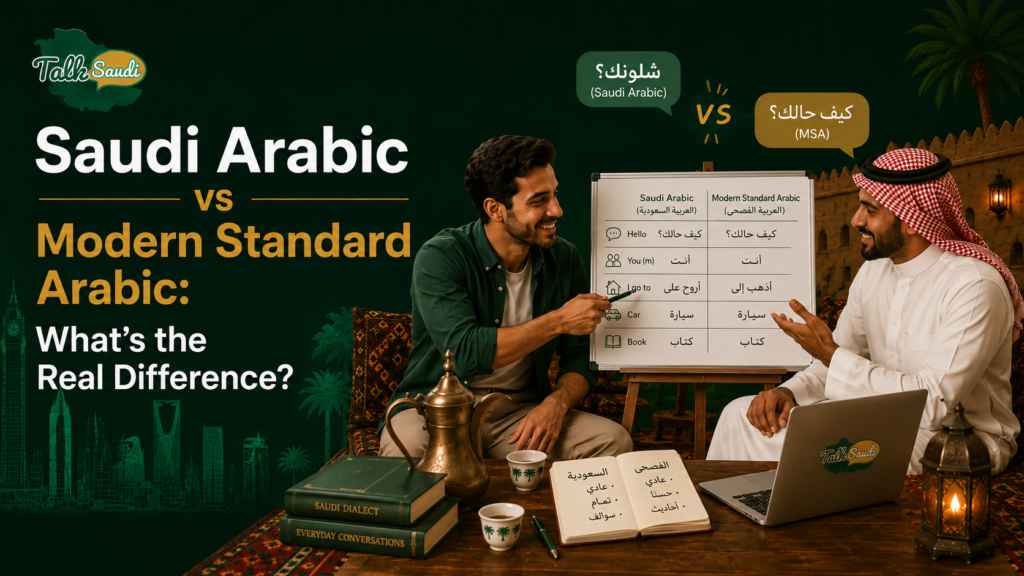
If you’ve ever studied Arabic for months and then landed in Riyadh or Jeddah only to feel completely lost in conversation, you’re not alone. This gap is exactly why so many learners search for Saudi Arabic vs Modern Standard Arabic, trying to understand why textbook Arabic doesn’t match what people actually say on the street.
The debate around Saudi Arabic vs Modern Standard Arabic isn’t just academic — it’s the key to real communication, real friendships, and truly feeling at home in the Kingdom. In this guide, we’ll break down Saudi Arabic vs Modern Standard Arabic in detail, so you know exactly which one you need, when, and why. If you’re completely new to the topic, our complete beginner’s guide to learning Saudi Arabic is a good companion read alongside this one.
What Is Modern Standard Arabic (MSA)?
Modern Standard Arabic is the formal, standardized form of Arabic used in news broadcasts, books, and official documents across the entire Arab world. When people compare Saudi Arabic vs Modern Standard Arabic, MSA is usually the “textbook” side of the equation — grammatically consistent and universally understood on paper, but rarely spoken casually by anyone, anywhere, even in formal settings.
What Is Saudi Arabic?
Saudi Arabic refers to the dialects spoken naturally across the Kingdom, varying by region between Najdi, Hijazi, and Eastern Province speech, among others. This is the living, breathing half of the Saudi Arabic vs Modern Standard Arabic conversation — the version you’ll actually hear in homes, markets, taxis, and business meetings. If you want a full breakdown of these regional accents and where the dialect comes from historically, we cover that in depth in our guide to what Saudi Arabic actually is.
The Core Differences Between Saudi Arabic and MSA
Understanding Saudi Arabic vs Modern Standard Arabic at a practical level means looking at four areas where the two diverge sharply: vocabulary, pronunciation, grammar, and sentence flow.
1. Vocabulary Differences
Many everyday Saudi words simply don’t exist in MSA, or carry different meanings entirely. A word that sounds perfectly formal in a news broadcast might never come up in a real Saudi conversation — and vice versa. This vocabulary gap is one of the clearest markers when comparing Saudi Arabic vs Modern Standard Arabic side by side, and it’s why phrasebooks built only around MSA leave learners stuck. For real, usable vocabulary, see our list of essential Saudi Arabic phrases for expats.
2. Pronunciation and Sound Changes
Saudi speakers often simplify or shift certain MSA sounds regionally, which is why someone fluent in MSA grammar can still struggle to follow fast, casual speech. Vowels get shortened, certain consonants soften, and the overall pace of speech is noticeably quicker than the deliberate, measured rhythm of formal Arabic.
3. Grammar Simplification
MSA follows strict case endings and formal verb conjugation patterns that are rarely used in daily speech. Saudi Arabic drops much of this complexity in favor of a flexible, conversational structure — which, in practice, makes it easier to start speaking than MSA, even though it takes real exposure to master.
4. Sentence Structure and Flow
MSA sentences are built for writing and formality, often long and layered. Saudi conversation is quicker, more direct, and relies heavily on shared cultural context, tone, and body language — things no textbook page can fully capture.
Saudi Arabic vs Modern Standard Arabic: A Side-by-Side Comparison
To make the Saudi Arabic vs Modern Standard Arabic distinction easy to picture, here’s how the two compare across the areas that matter most to learners:
- Primary use: MSA is used for news, books, and formal writing. Saudi Arabic is used for daily conversation and everyday business chat.
- Vocabulary: MSA vocabulary is standardized across the entire Arab world. Saudi Arabic vocabulary is regional, with unique expressions that shift from city to city.
- Grammar: MSA follows complex, strict rules, including case endings. Saudi Arabic is simplified and flexible, built for speed and ease of speech.
- Where it’s learned: MSA is learned in schools and from textbooks. Saudi Arabic is learned through real-life immersion, native speakers, and structured dialect coaching.
- Regional variation: MSA has essentially none — it’s the same everywhere. Saudi Arabic varies noticeably between Najdi, Hijazi, and Eastern dialects.
- Emotional tone: MSA is formal and neutral. Saudi Arabic is warm, expressive, and culturally rich, often woven with blessings and hospitality.
This comparison is exactly why picking the right one to study first matters so much for your goals.
Why Most Traditional Arabic Courses Get This Wrong
Most Arabic programs default to teaching MSA because it’s standardized and easier to build a curriculum around. But this creates a real gap in the Saudi Arabic vs Modern Standard Arabic debate: students graduate fluent in grammar rules yet unable to follow a simple restaurant conversation in Riyadh, or hold their own in a casual chat with a Saudi colleague.
Which One Should You Learn First?
Deciding between Saudi Arabic vs Modern Standard Arabic depends entirely on your goals.
Learn Saudi Arabic first if:
- You’re living, working, or traveling in Saudi Arabia
- You want real friendships and genuine social connection
- You need daily conversational fluency, fast
Learn MSA first if:
- You need formal reading or writing skills
- You’re studying Arabic academically or for religious texts
- You’re pursuing journalism, translation, or diplomacy
For most expats, travelers, and anyone building relationships in the Kingdom, spoken dialect is the more urgent priority — and it’s entirely possible to build confidence quickly with the right approach, as we explain in how to speak Saudi dialect with confidence, fast.
Common Myths About Saudi Arabic and MSA
Myth 1: “Learning MSA means I’ll understand Saudi dialect automatically.” This misconception fuels a lot of confusion around Saudi Arabic vs Modern Standard Arabic. MSA gives you grammatical foundations, not fluency in fast, regional speech — the two are related, but far from interchangeable.
Myth 2: “Saudi Arabic is just broken Arabic.” Not true. It’s a fully developed linguistic system with its own consistent internal logic, not a lesser or “incorrect” form of the language.
Myth 3: “Dialects can’t be learned without living there.” Structured lessons with native instructors can shorten this curve dramatically — you don’t need to relocate to the Kingdom to build real conversational ability.
How Long Does It Take to Learn Saudi Arabic?
Timelines vary by learner, but a realistic path generally looks like this:
- Beginner (1–2 months): Greetings, numbers, and simple everyday phrases
- Elementary (3–4 months): Basic conversations and daily routines
- Intermediate (5–8 months): Following fast native speech comfortably
- Advanced (9–12+ months): Near-natural fluency, including humor and cultural nuance
Consistent live practice speeds up mastering Saudi Arabic vs Modern Standard Arabic far more than solo textbook study ever could — dialects are learned by ear and repetition, not by memorizing rules.
Why Live, One-on-One Instruction Matters
Dialects live in tone, rhythm, and cultural context — things static text simply can’t teach. This is where the Saudi Arabic vs Modern Standard Arabic divide becomes most obvious: a native instructor can correct your pronunciation in real time, explain cultural nuance no app can replicate, and adjust lessons to the specific regional accent you actually need.
Real-Life Scenarios Where This Difference Matters
Scenario 1: Business meetings. Formal presentations may lean on MSA, but real negotiation and trust-building almost always happen in dialect.
Scenario 2: Making friends. Speaking someone’s everyday dialect builds a warmth that formal Arabic simply can’t replicate.
Scenario 3: Travel and daily life. Ordering food, taking taxis, and chatting with shop owners all run on dialect, not formal Arabic — a handful of the right phrases go a long way here, as covered in our guide to Saudi Arabic phrases every expat should know.
How to Start Learning Saudi Arabic the Right Way
- Identify your goal — travel, relocation, business, or personal interest
- Choose dialect-focused instruction over generic MSA-only courses
- Prioritize live conversation practice over passive study
- Learn in structured levels, building from greetings to full conversations
- Immerse in culture, not just vocabulary — tone and context matter as much as words
Understanding Saudi Arabic vs Modern Standard Arabic is the first step; committing to live, conversation-first instruction is what actually gets you speaking. For a full roadmap from zero to conversational, start with our beginner’s guide to learning Saudi Arabic.
Frequently Asked Questions
What is the real difference between Saudi Arabic vs Modern Standard Arabic? Saudi Arabic is the spoken dialect used daily across the Kingdom, while MSA is the formal, standardized language used in writing and media.
Can I use MSA to communicate in Saudi Arabia? Yes, but it sounds overly formal and stiff in casual settings — people will understand you, but conversations will feel noticeably stilted.
Is Saudi Arabic hard to learn? Generally easier conversationally than MSA, thanks to simpler grammar and fewer strict rules to memorize before you can start speaking.
Do all Saudis speak the same dialect? No — it varies by region, primarily between Najdi, Hijazi, and Eastern Province speech, each with its own vocabulary and rhythm.
Should I learn MSA before Saudi Arabic? Not necessarily. Many learners start directly with the dialect if speaking is the goal, since MSA isn’t a prerequisite for conversational fluency.
How long until I’m conversational? Often three to four months with consistent practice, with deeper fluency developing by eight to twelve months.
Is Saudi Arabic useful outside Saudi Arabia? Yes — it overlaps significantly with other Gulf dialects spoken in Bahrain, Qatar, Kuwait, and the UAE.
What’s the best way to learn as a beginner? Live, one-on-one instruction with native speakers and a structured curriculum, rather than generic apps or MSA-only courses.
Can teens learn the same way? Yes — personalized live instruction adapts well across age groups, from teens to adult professionals.
Is online learning effective for this? Absolutely. Live online sessions replicate much of the immersive benefit of in-person learning, especially when paired with consistent practice.
Final Thoughts
The gap between Saudi Arabic vs Modern Standard Arabic is the difference between studying Arabic and actually living it. If your goal is genuine connection, prioritizing the spoken dialect side of this comparison will get you there faster than any textbook — and that’s exactly what Talksaudi helps you do through live lessons with native instructors.
If this guide helped clarify Saudi Arabic vs Modern Standard Arabic, share it with fellow learners, and explore our related guides on learning Saudi Arabic as a complete beginner, must-know Saudi Arabic phrases for expats, and how to speak Saudi dialect with confidence.